Doesn't Lend Me His Toy
Weeping like a toddler over a perceived injustice that was, in reality, purely mundane. Have you ever identified with this scene?
This is the feeling I had at 17, when I composed the eighth song of my novice first album.
More than 15 years later, I set out to reconstruct it with a different perspective for my album of artistic reconstructions, Rocking Horse Glittered:
When I looked back at that stick-figure of a song I made at 17, I had to sit down and think about how I would transmute it into a work of art.
Originally, my song was an expression titled something like "This Damn World," and with sad violins, I tried to sketch sorrow into that poor, basic work.
The truth is that at 17, I knew almost nothing about life or the world, so I was really victimizing myself, dramatizing my life as if I were living in a tragedy. I won't be too hard on myself, though—I mean, we had been poor in my house my whole life; sometimes we had crackers or chisitos (which were quite cheap) for lunch, so I won't deny that I knew something of life’s hardness. But I didn't even have an idea of the why or the how of those situations, and it was evident the song only aimed at an abstract victimhood of things I hadn't even experienced yet (but that would soon be knocking at my door).
How to convert this infantile, ignorant, and erroneous vision into a deeper work? After meditating for a few days, the spirit of where I wanted to head arrived, and with it, the name of the song: "Doesn't Lend Me His Toy."
What I simply did was stand at a distance, as if looking at myself from afar when I made that first version. I laughed inside, thinking: "If you only knew how hard life is going to hit you in the coming years..." I felt as if, at that time, I was a toddler sobbing because someone didn't want to lend me their toy, complaining in anguished cries to my mother about how unfair the situation was.
What seemed genuine at that time could now be seen much more clearly… the Styrofoam scenery was falling apart, and the curtain was closing while the lights of the poor show flickered before empty seats. In other words, my problems were like tickles, and the world I knew was a fairy tale compared to what would come in the following years.
With the concept established, I want to explain a bit about the melody and structure. For the beginning, I wanted to do something that marked the era when I first started the track, something I didn't actually like very much: electronic music.
But it wasn't just any electronic music. In that post-2000 era, there was music close to the "rhythmic noise" genre or some branch of industrial hard techno; it was basically an experimental stage where electronic songs mixed with an excess of noise-making instruments were in style. It was like "thrash metal"—I’d define it as "thrash electronic".
If I’m not mistaken, they were heavily influenced by a series of German musicians from that time. I remember one night I went to sleep with the radio on—I had to go to school the next day—and I recall having a hard time sleeping because there was a 20-minute track of this type of music repeating on a loop. The base wasn't bad, but on top of it, random object noises played repeatedly. For example, that particular track had a sound like two bricks scraping together, over and over. It wasn't just equalizers; they were actual noises of bricks, metals, and things like that, but without variety—flat, repeating incessantly. It felt like true mental torture.
Anyway, that’s how I started the track. First, it’s electronic, becoming noisy, increasingly loud, and this noise represents the problems that don't let you think. Have you ever felt there was so much noise in your life that it was hard to even think?
For the base rhythm that fades in, I based it on the rhythm made by the water tank at my house filling up with the Piston Water Pump (since there is no running water in my town). Practically, that is a sound I’ve heard almost my entire life.
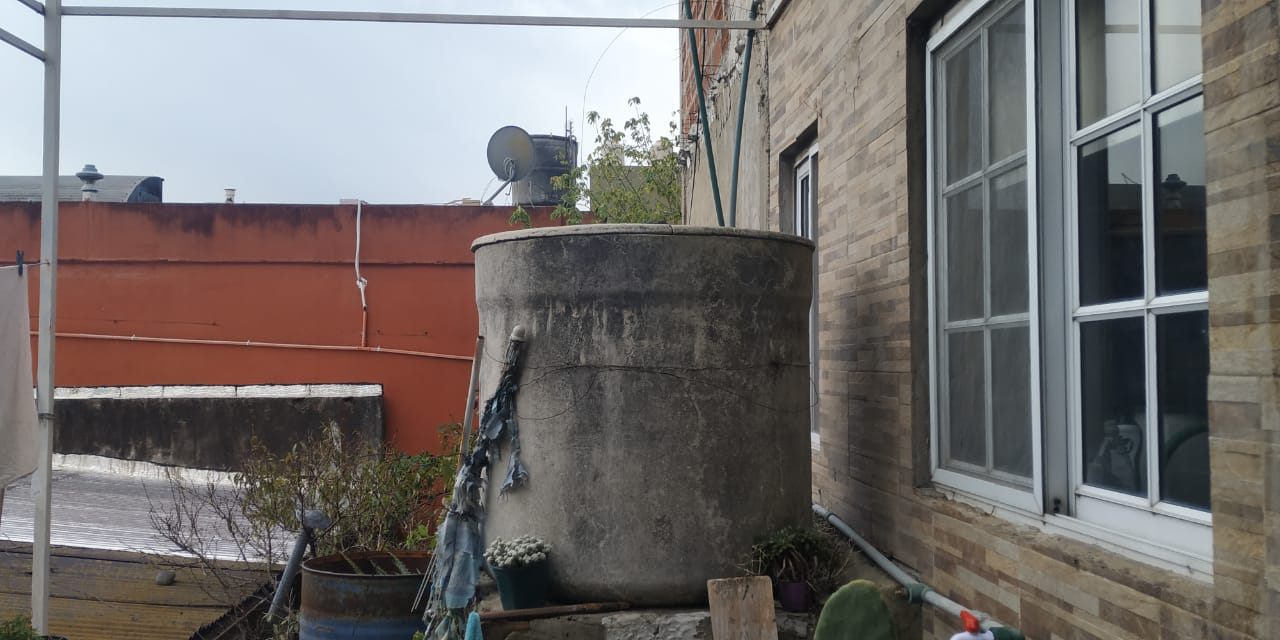
So the song begins with a succession of moderately organized noises and rhythms, until at a certain point, a noise appears that is out of place and breaks the harmony, just as happened with the music of that era. This noise, which seems to become a headache, sounds for a few seconds, symbolizing the problem escalating to a chaotic level in the mind.
So, what comes after the noise?… After war?… After a crisis?… Silence, peace. The electronic music stops, the noises cease to exist. A sort of radio tone begins to play, repeating as if the noise were going to continue, but then a digital wavetable synthesizer enters, granting harmony and calm, as if being underwater.
If you’ve ever had a noisy problem or crisis so great in your mind, you know there comes a point where silence and a strange calm arrive. It’s the same thing that happens with fear, when the body becomes so exhausted from being in panic that it no longer wants to escape.
The noise of that era was the cry of a child crying over a whim, throwing a tantrum. But his problems will soon become real, and his mind will collapse into a state of false peace, while chaos reigns around him for a long time. That false peace, that mental crisis in a deceptive silence, in the eye of the storm, is what that part represents. It is bittersweet, because it is a somewhat comforting peace that emerges from the noise, but at the same time, it announces that you have crossed a point of no return.
The rest of the track (which lasts several minutes) is built on that foundation, on that broken mind. A guitar appears, taking voice, first appearing to accompany. Then, the lead is taken by an electric guitar that complains quite a bit, as if peace exists but the child is still crying inside. The guitar becomes shriller, changing effects, until reaching the climax: twin guitars. That is the peak of the weeping.
At the end, a guitar sounds with an effect similar to the Marshall YJM100, performing a sort of "wide fast vibrato" in the style of Mike Oldfield.
It must be said that during all of this, the instruments become somewhat disorganized, though they continue to take turns and respect a certain structure, showing that harmony and chaos are built in the same place.
The guitars stop at a final vibrato, and only the background base remains, repeating infinitely, because the weeping disappears but the problems are still there.